
A broken undercarriage pivot
 A new part in the process
A new part in the processIans F15 Eagle
Today was a near perfect day. No one had a serious accident, Jims new jet had a bit of a kangaroo landing and scratched some paint, but no serious damage, and I lost a tail wheel from the Yak, hey-ho!
I tried out my KT120fsT this evening (before it rained) and got nowhere with it, It still stops when hot, and it certainly gets hot, too hot, but the engine isn't tightening up as its free to turn over by hand immediately after stopping. There is some pre-ignition at times and I think this may be a clue to the problem. I may have to have a closer look at the valve timing, and/or place yet another gasket under the cylinder heads. Some experimentation required.
Ketro KT120fsT in action
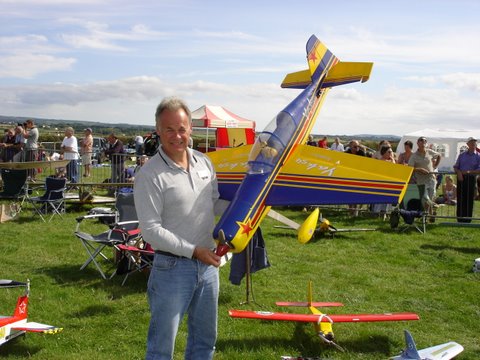 Me with Yak 54, photo courtesy of Geoff.
There were some nice aircraft to be seen at the show including a Stirling bomber, a deHavilland Mosquito and a Spitfire. A few jets put in an appearance with a Rookie, Kangaroo, Boomerang and an F16 flown very realistically by its skillful pilot. The electric slot was well over subscribed so the time allocation was doubled, electric gliders and slower craft first, followed by the faster EDF (Electric Ducted Fan) jets and other fast craft. That included me with the Pico-Jet.
A 180 panoramic
deHavilland Mosquito built and flown by Roger Kellow
Rogers Mozzie developed a problem during flight in that the undercarriage failed to lock down, but was able to recover from the situation and landed safely. Well done Roger.
Also impressive was a helicopter built by Kim Johns. Now helicopters leave me cold, I just can't get interested yet I feel compelled to watch in case it starts heading this way in an uncontrolled manner. But this was different. Modified and developed to accept a gas turbine, it was flown expertly by Mark Milne and performed just like a full sized helicopter. Even the sound and smell was the same. I'm told its the only one of its kind in the world - very impressive.
 Conrods with small end bearings fitted
You can see what I mean by the diamond shape...
I need to cut the same on the other side.
 Crankshaft during remanufacture
Ians F16 is always an impressive display.
Two flights with each aircraft today, and I brought them all home in one piece - a very satisfying day.
 2010 to be engraved
 The Craftmans Cup 2007
 The Craftmans Cup 2010
Jig set up for silver soldering the big end journals into place.
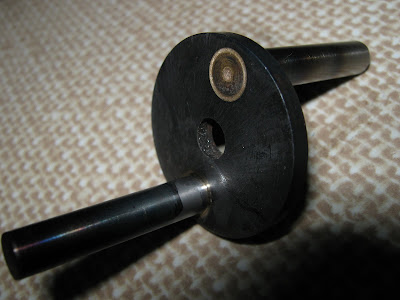
The new Central Web complete with Big End Journals
The journals are too long at the moment and will have to be cut to length to enable fitting between the front and rear crank webs.
I removed the shaft from the gear box because the bearing was lumpy, but it worked fine after I'd taken it out, so I cleaned it all up and noticed the shaft was bent. This could be the cause of the lumpyness, so shaft straightened and re-assembled into housing, it now works fine again.

Broken crank pin
After tea I began dismantling the engine and it wasn't long before I discovered the crank pin on the central web had severed. I've also noticed the other pin in the web is loose. I must have done a poor soldering job there. Nothing else in the engine is damaged although the bearing in the gear box housing is a bit lumpy. I think I will change it.
 A sorry sight
 View of the front underside
The carb is mounted with a 4.5mm offset. This is to compensate for the differing lengths of delivery tube. (They are different due to the 9.0mm cylinder offset.) The 4.5mm offset makes the mixture transit distance equal to both port and starboard cylinders.
 Temporary fitting to the firewall
 View of the rear with mount removed to show delivery tubes
The delivery tube system is made from 10mm micro bore tube and two standard elbow fittings. These fittings were modified to remove the solder ring and to add lightness. The two joints either side of the carb are butt joints. All the joints on the delivery tubes are silver soldered and there is a spigot silver soldered to the main part which extends into the carburettor manifold and the aluminium adaptor is glued to the spigot using Loctite 603 oil tolerant retainer. The carburettor is held in place using two M3 grub screws.
 I can hear it running already!
 Lightening holes (Not lightning holes)
I also made the exhaust pipes, large in diameter to muffle the bark. Aluminium inserts are pressed into each end of a stainless steel tube and the assembly is screwed to the cylinder head using an M3 socket cap head screw.
 Exhaust stacks fitted
I went flying today as the forecast was good and with light winds. 'Tiz different when you get there, it was good earlier but the wind got stronger for the North West and by lunch time it was really cutting and Ipacked up and went home. Not before flying the Sunbeam and the Pico-Jet, and on the second flight with the Pico-Jet the prop parted company with the motor. All the bits flew off and scattered on the runway - time to land.
Phil was there with his Funtana. Look at the kit he's got to charge the batteries. That's not all, there's also a generator to power it all up.
 No less than FOUR chargers
Phils Funtana
Exit left
 Bags of room inside - Could've built a bigger engine
 Exposed, showing the mount.
 6mm dia. base, 8mm dia. spacers tapped M4 both ends
 4 Degree angle
 Base is made from cast plate for lightness
Phil shows how its done.
One thing that surprised me was the noise, it got very loud at times and the high pitch really gets on your top note. Its not the propeller or the motor, but the speed controller that makes the noise. Next time I'll wear ear muffs and maybe, if I remember, I'll take along a decibel meter. We might have to fit silencers for indoor work.
The Vapours


Blanks cut from the material they're sat on. (5mm Gauge plate)

The fixture for cutting the necking.

Ready to start machining...
I learned today the results of my AGM proposal to pit on the North side of the runway when the wind is from the South. A resounding failure in the voting, 5 for, 19 against. The reasons given were due to a motor cycle training school setting up on the Southern perimeter and the main road being nearby. In fact, setting up on the South side means you are a runways' width closer to both. Oh! well, I guess I'll not be going flying when the wind is from the South in future as I don't feel safe in the pits when others are taking off towards the South side. I wonder if someone decides to set up a business near the North side of the runway or on the Hammer head, if we'll get kicked off the site due to health and safety reasons. It could so easily happen.

 Upper side showing assembly detail. See also last Photo
 Underside, showing cam shaft housing
 Its all in the detail

Gearbox started


 Gearbox cover detail


